< Previous 2013 August Cut steel beads, Portrait Next >
|
 | | August 2013 | | www.morninggloryjewelry.com | |  | |
Welcome to Morning Glory Antiques & Jewelry!
| We add articles, reference pages and recent acquisitions continually, so browse, enjoy, and feel free to email us with your comments or suggestions.
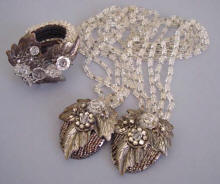
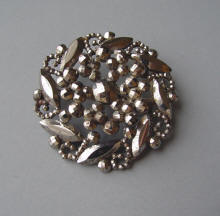
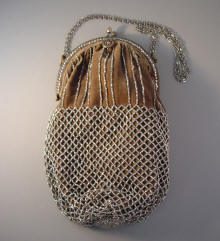
| FEATURE: VICTORIAN Cut Steel | CUT STEEL BEADS are faceted metal beads, often silver in color, that give off a gentle sparkle both when used alone or mixed with beads or rhinestones. They impart a vintage flair even to a more modern piece. Robert Clarke used them in many of his creations for Miriam Haskell in the 1950s and 1960s, purses have been decorated with them from the Georgian era (late 1700s to early 1800s) right up to today, and they can be found in jewelry, purses and other ornaments. CUT STEEL is polished steel faceted studs riveted to a steel backing and used to create jewelry and ornaments, buttons and chatelaines. Popular from the Georgian through the Victorian eras, cut steel jewelry in the warm glow of candlelight must have been something to behold. Motifs varied from the simple to the sublime, with multiple layers and densely packed studs. Designs could be enhanced by the use of varying sized studs as well. Each stud could have up to 15 facets, and in general the finer and older the piece the more facets the studs will have. Made in both England and Europe, this style of jewelry fell out of favor around the turn of the 19th century, but it never falls out of favor with me.
Woodstock was a small town outside Oxford, England, site of the most famous cut steel workshops circa 1760s. A jeweler during that time may have been selling cut steel jewelry a price higher than gold. Steel jewellery became fashionable in France and its enormous cost made it popular with the nobility. Napoleon, on his second marriage to Marie-Louise of Austria commissioned a whole parure of cut steel for his new bride. By 1775, Mathew Boulton was the most famous steel worker, first in London and then in Birmingham. By the 1790s the industry was producing its finest work although the French Revolution robbed the British workshops of their best customer. Though many shops in England closed, the French cut steel industry survived to the turn of the 19th century. Since cut steel will rust if it gets wet or damp and is difficult to polish or clean, much of it has been discarded and a relative few good pieces remain today. I would date the piece at left between 1775-1800 as the individual brads are quite small. In general, the smaller the pieces of cut steel used in the jewelry, the earlier the item was. Later jewelry had larger cut steel brads.
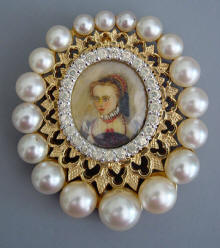
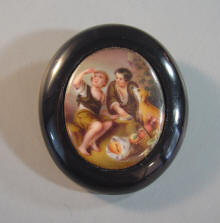
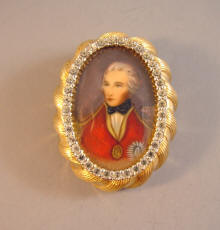
To BUY these wonderful pieces for your collection, please CLICK HERE. | FEATURE: PORTRAIT Jewelry | In the days before photography, a hand-painted portrait miniature was a desirable keepsake or love token. While some of these miniature art works were done of actual people including both royalty and everyday folks, others were painted of mythological characters and idealized lovely ladies. Mother-of-pearl, ivory and vellum were often used as paint surfaces. Settings ranged from the simplest rolled gold twist frame brooch to gem encrusted wonders. Artists who did portrait miniatures were called "limners" and they did not only pieces for jewelry, but also work meant to be framed for display, often in lacquered wood or ivory embellished frames. Some traveled from city to city taking commissions as they went. Portraits could be worn on velvet ribbons around the neck, as brooches, rings and bracelets, and in lockets. Even men worn portraits suspended around the neck under their shirts.
Whether hand painted on ivory, porcelain, paper or mother-of-pearl it can be set in gold with precious gems, mounted on jet or simply costume jewelry. It can be a lovely lady, a dignified gentleman or a charming child. And it has continued well into the 20th century, with Rosenstein being one of the most desirable makers of this category of jewelry. Artist-signed pieces, lovely ladies and children, dated pieces and identifiable individuals often command the highest prices. Portraits that combine enclosures for hair or include an engraved notation are also sought after. Portrait jewelry is a sentimental favorite, a personality captured in time and a classic fashion accessory.
Available PORTRAIT JEWELRY for sale can be seen by clicking HERE .
A Gallery of PORTRAIT JEWELRY can be seen here. | | |
| | | | | | | |
|
Enter your email address below to subscribe to the Morning Glory Newsletter.