Reference Information |
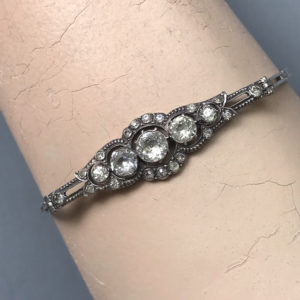
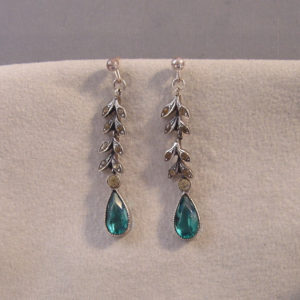
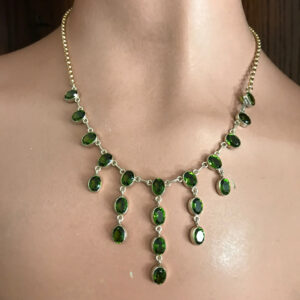
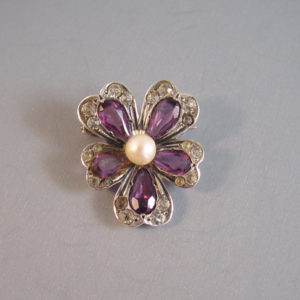
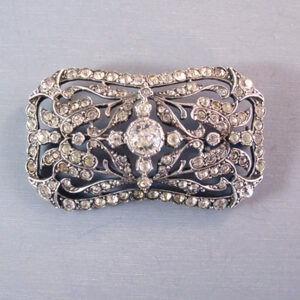
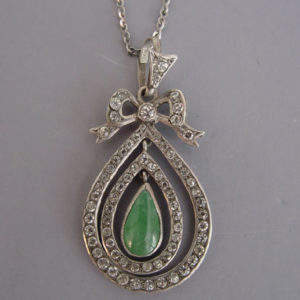
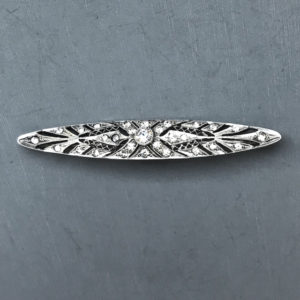
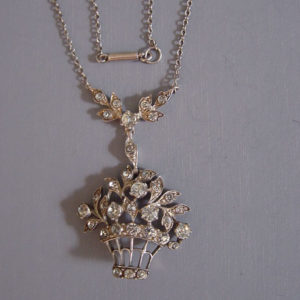
Paste JewelryPastes, according to Antique Paste Jewellery by Malcolm David Samuel Lewis, is \”glass which has been cut into gem-like forms\”. They were used extensively from the 1700s to the early 1900s and were a desired material in themselves, not a replacement for diamonds and gem stones. Invented by Georges Frederic Strass (1701-1773) in 1730, they could be set in silver, sterling or gold and could have been foiled or unfoiled (although 18th century paste was always foiled). Foiled pastes were usually seen in closed-backed settings where the foil provided added reflection and brilliance. Pastes could be much more readily cut and shaped than diamonds, making a close-fitting pave look achievable, and a variety of shaped and sized stones makes a paste piece more desirable. Perfectly round stones will not be found in the early and best paste jewelry, nor will claw settings and knife-edge work. Cut down settings gave way to the coronet setting only in the 19th century. Paste could be fashioned in different colors, including an opaline cabochon similar to opals. Most paste came from France, England, Spain or Portugal. Some later pieces were hallmarked. 18th century paste was normally higher quality work than were the 19th century pieces. Part of the reason for that was attitude and part was the political climate. Also, an 18th century paste piece made would have been made by a single jeweler who highly valued both the material and the craft. Later, a piece of paste jewelry might have one man who crafted the setting, another who set the stones, and the piece may have been designed by yet a third person. The introduction of paste in 1730 made the term \”Age of Paste\” applicable to the 18th century and their shimmer is as appealing today as it was when they were made. According to Antique Paste Jewellery, paste was only made from circa 1700-1865 but the term has been more generalized to include pieces up to the 1930-40s, and for some it is used to describe jewelry even later than that. But beware… paste has been reproduced for many years and it can be extremely difficult to distinguish old from new. Findings may also be replacements so it is good, as always, to do your research and buy from a reputable dealer. 8 relevant items
|

- New Additions
- Browse by Category
- Browse by Designer
- Boucher (2)
- Carnegie (6)
- Coro (8)
- Costume Jewelry, unsigned (98)
- DeMario, Eugene (2)
- DeRosa (112)
- Eisenberg (4)
- Hobe (35)
- Juliana (9)
- McClelland Barclay (5)
- Miriam Haskell (29)
- Regency (4)
- Rosenstein (3)
- Schiaparelli (3)
- Schreiner (1)
- Shultz bakelite (34)
- Signed Jewelry (89)
- Signed, misc (15)
- Swarovski (33)
- Trifari (15)
- Vendome (5)
- Vrba (13)
- Weiss (1)
- Browse by Era
- Information / Research